

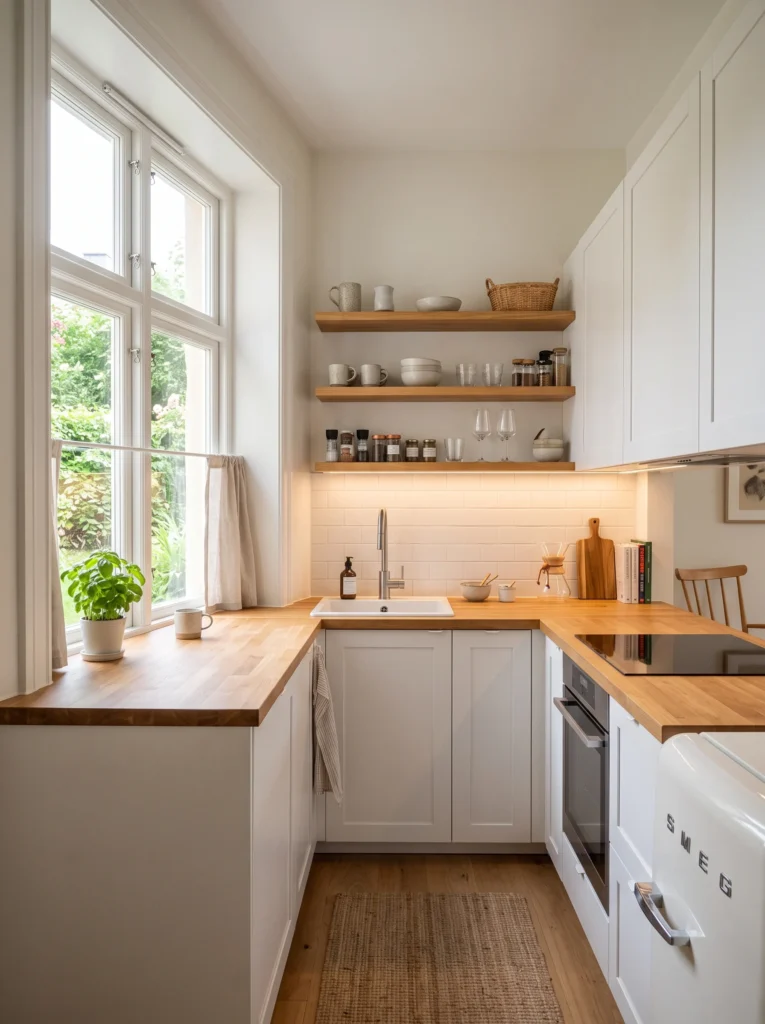
My first apartment kitchen was so small that opening the oven door and the fridge door at the same time was physically impossible. Two people couldn’t stand in it together without one of us turning sideways. I lived there for three years, and somewhere around year two, that kitchen stopped feeling cramped. Nothing got bigger. I just got smarter about it.
That’s really the whole premise of this article: square footage doesn’t change, but the feeling of space absolutely can, and almost none of it requires a contractor.
Light Does More Work Than People Expect
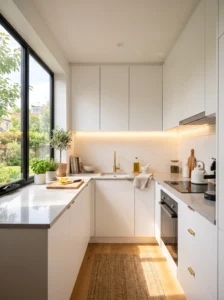
Before touching layout or storage, look at where your light is actually going. A small kitchen lit only from one harsh overhead bulb will always feel boxed in, no matter how tidy it is.
In my old place, switching from one yellow-toned ceiling bulb to two cooler-toned LED strips under the cabinets changed the room more than any organizing project did. Light that comes from multiple angles — overhead, under-cabinet, maybe a small lamp near a window — removes the heavy shadows that make corners feel like they’re closing in.
If you rent and can’t install fixtures, plug-in LED strip lights under cabinets solve most of this without a single tool.
Color Choices That Quietly Expand a Room
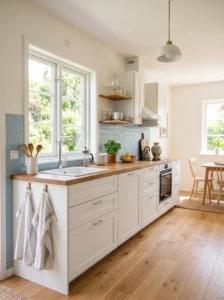
This one’s almost too simple to believe, but it holds up: light, cool-toned colors visually push walls outward, while dark, warm-toned colors visually pull them in.
You don’t need to repaint anything to use this. A few low-effort swaps:
- Light-colored dish towels and rugs instead of dark, busy patterns
- A pale or white backsplash if you’re already replacing one
- Cabinet hardware in a single light finish instead of mixed metals
None of these are renovation-level changes, but together they shift how the whole room reads.
Mirrors and Glass Aren’t Just for Bathrooms
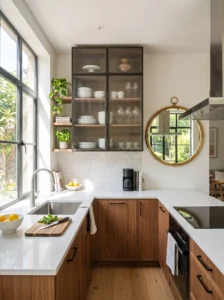
A small mirror placed opposite a window, or even just near the dining area of a kitchen, bounces light back into the room and creates the illusion of an extra few feet. I added one small mirror across from my kitchen window in that first apartment, and guests genuinely asked if I’d knocked down a wall.
Glass cabinet fronts do something similar on a smaller scale — they let your eye pass through instead of stopping at a solid door, which makes the cabinet feel less like a wall.
Vertical Space Is the Most Wasted Space in Small Kitchens
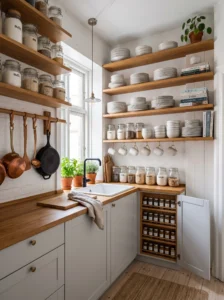
Most small kitchens are crowded at counter height and nearly empty above eye level. That imbalance is part of why the room feels tight — all the visual weight sits low.
Go Up, Not Out
- Install one or two open shelves near the ceiling for items you rarely use
- Add a hanging pot rack instead of a deep, bulky cabinet for pots
- Use the inside of a cabinet door for spice racks or lid organizers
Moving even 15-20% of your stored items upward frees counter and lower-cabinet space, and a room with balanced visual weight from floor to ceiling reads as larger than one that’s crowded only at hand height.
The Furniture Mistake That Shrinks a Kitchen Instantly
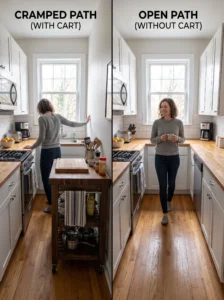
If your kitchen has a table, cart, or extra storage piece that doesn’t quite fit the footprint, it’s probably doing more damage than you realize. One oversized item — even something useful — can make an otherwise reasonable kitchen feel like a hallway.
I learned this the hard way with a rolling kitchen cart I bought to “add storage.” It actually narrowed my main walking path by almost a third, and I felt the cramped feeling every single day before I admitted the cart was the problem, not the kitchen.
A Quick Test
Walk your main path through the kitchen — sink to stove to fridge. If you have to angle your body sideways anywhere along that path, something in the room is too big for the space, regardless of how useful it is.
Reflective and Multi-Use Surfaces Change How a Room Reads
Stainless steel appliances, glossy cabinet finishes, and even a simple glass countertop protector all reflect light slightly, which softens the boxed-in feeling small kitchens tend to have.
Multi-use furniture helps too — a narrow rolling cart that tucks fully under a counter when not needed, or a fold-down shelf instead of a fixed one, gives you function without permanently claiming floor space.
Clutter Control Matters More Here Than in Any Other Room
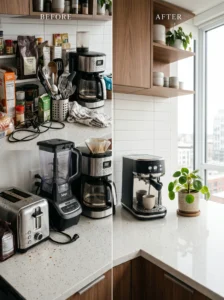
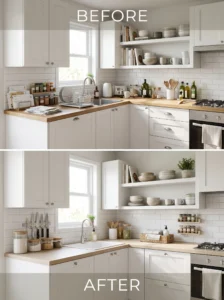
A small kitchen with visible clutter looks dramatically smaller than a small kitchen with the exact same square footage and clear counters. This isn’t about owning less — it’s about what stays visible day to day.
A few low-effort habits:
- Keep no more than two small appliances permanently on the counter
- Store everyday dishes within easy reach, but keep rarely-used items higher up or in a closet
- Clear at least one continuous stretch of counter completely — even a small one
This single habit, more than any paint color or light fixture, is usually what separates a small kitchen that feels “cozy” from one that feels “cramped.”
Putting It All Together
None of these changes alone will transform a kitchen overnight. But layered together — better light, lighter colors, one strategic mirror, balanced vertical storage, right-sized furniture, and a genuinely clear counter — they add up to a room that behaves bigger than its actual measurements, even though the walls never moved.
That’s really the trick behind every “small space” solution that works: you’re not fighting the square footage, you’re managing how a person’s eyes and body move through it.
Quick Summary
- Multi-directional light removes the shadows that make corners feel tight
- Light, cool tones visually expand a room more than dark, busy colors
- A single well-placed mirror or glass surface bounces light effectively
- Vertical storage balances visual weight and frees up crowded lower space
- Oversized furniture often hurts more than it helps in tight layouts
- Clear counters consistently make the biggest visible difference
Conclusion
A small kitchen isn’t a problem to renovate your way out of — it’s a layout to work with. The fixes that actually move the needle are mostly about light, color, sightlines, and what you choose to leave visible, not about square footage you don’t have.
Start with the lowest-effort changes first — lighting and counter clearing — before you spend money on anything else. In my experience, those two alone solve more of the “small and cramped” feeling than people expect.
Frequently Asked Questions
Does paint color really make a measurable difference in a small kitchen? Yes, though it’s a perceptual difference rather than a physical one. Light, cool-toned surfaces reflect more light and create fewer visual stopping points than dark or busy colors, which is why painters and designers consistently recommend lighter palettes for tight spaces.
Is it better to remove cabinet doors entirely in a small kitchen? It can help in specific spots, especially above eye level where open shelving adds light visual texture instead of a solid block. It’s not necessary everywhere, though — a mix of a few open shelves with mostly closed storage usually works better than removing all doors.
How many mirrors does a small kitchen actually need? Usually just one, placed where it reflects a window or a light source. Adding several mirrors can start to feel busy and actually works against the calm, open effect you’re going for.
Will a kitchen island make a small kitchen feel bigger or smaller? In most genuinely small kitchens, a fixed island makes the space feel smaller by narrowing the walking path. A small, movable cart that can be pushed aside or tucked under a counter is usually the safer choice.
What’s the single fastest change for a small kitchen that feels cluttered? Clearing one continuous stretch of counter completely, even a short one. It’s the lowest-effort, lowest-cost change on this list, and it tends to produce the most immediate visible difference.