

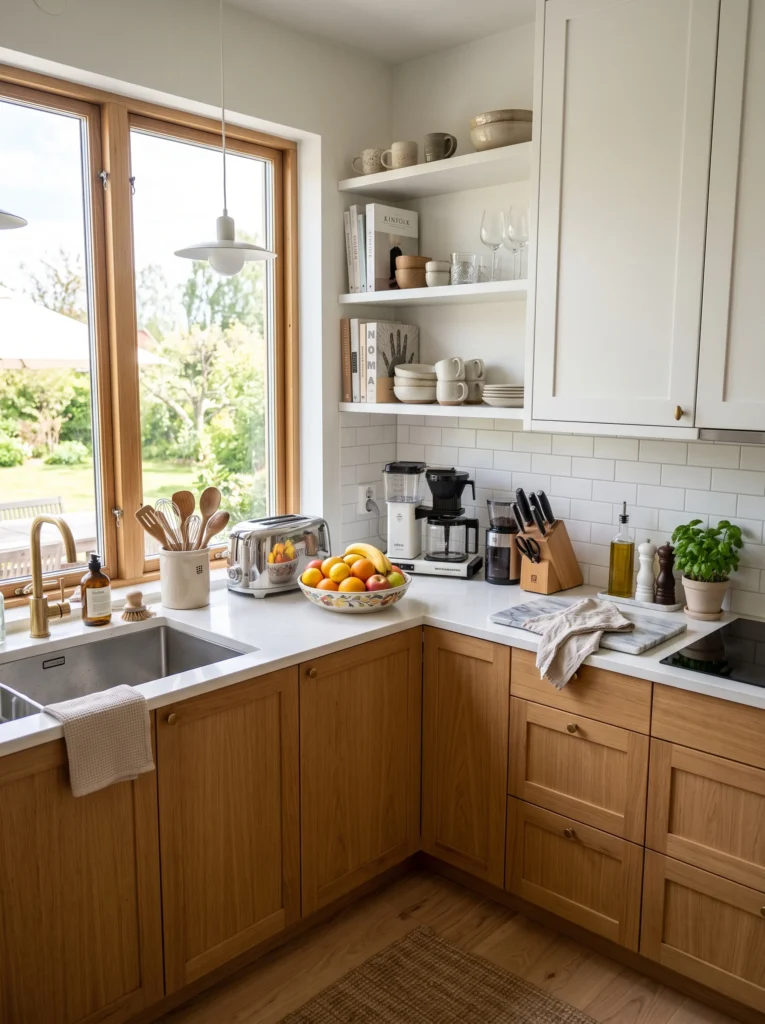
Last Tuesday I wiped every counter, put away every dish, and even scrubbed the stove twice — and twenty minutes later, the kitchen still felt messy. Nothing was dirty. Nothing was out of place. It just didn’t feel done.
If that sounds familiar, you’re not imagining it, and you’re definitely not bad at cleaning. What you’re noticing has almost nothing to do with dirt and almost everything to do with how your eyes process a room.
I’ve moved through four kitchens in the last eight years — two rentals, one tiny studio, and the one I’m in now — and the “clean but cluttered” feeling showed up in every single one, regardless of size. So I started paying closer attention to why.
Dirty and Cluttered Are Two Completely Different Problems
People use these words interchangeably, but they describe two unrelated things.
Dirty means grime, crumbs, sticky spots, dust. You fix that with a cloth and some spray. Cluttered means visual overload — too many objects, shapes, and colors competing for attention in one space. You can’t spray that away.
A kitchen can be germ-free and still feel chaotic. It can also be a little dusty in a corner and still feel calm. Once I separated these two ideas in my head, cleaning stopped feeling pointless, because I finally understood why scrubbing harder wasn’t solving the actual issue.
Your Eyes Are Doing More Work Than You Think
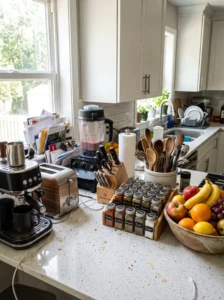
Here’s something nobody tells you when you move into a new place: a counter with twelve different items on it, even if every item is spotless and useful, reads as “busy” to your brain before you’ve consciously registered a single object.
This is sometimes called visual noise, and kitchens are especially prone to it because we fill counters with small appliances, jars, utensil holders, and mail we meant to deal with three days ago.
Why Identical Mess Feels Worse in a Kitchen Than a Living Room
A living room with ten random objects on a shelf can look “curated.” A kitchen counter with ten random objects looks like a problem. I think this comes down to shape and color variety — kitchen items are rarely matched in tone or material, so they clash more obviously than books or decor pieces do.
In my current place, I noticed the toaster, the coffee maker, a fruit bowl, a paper towel holder, and a knife block all sat on one stretch of counter — five different colors, five different shapes, all in eyeshot at once. Nothing was dirty. It still looked loud.
The Appliance Trap Almost Everyone Falls Into
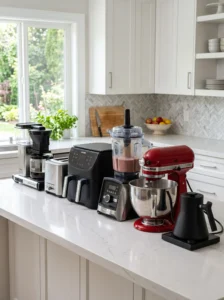
This is the part I underestimated for years. Small appliances are the single biggest source of “clean but cluttered” kitchens, and most people don’t connect the two.
A coffee maker, toaster, air fryer, blender, and stand mixer left out permanently isn’t a storage failure — it’s a visibility failure. Each one is small on its own. Lined up together, they form a wall of plastic and metal that your eyes can’t skip past.
A few things I’ve tested that actually help:
- Keep only the one or two appliances you use daily on the counter
- Store weekly-use appliances in a low cabinet, not a high shelf you’ll avoid using
- Group remaining counter items by color or material so they read as one set, not five
None of this is about owning less. It’s about what’s visible at any given moment.
Storage Isn’t the Same Thing as Organization
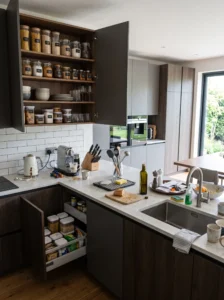
I used to think “more storage” would fix clutter. Then I moved into a kitchen with double the cabinet space of my old one, and it still felt cluttered within a month.
Storage gives you somewhere to put things. Organization decides what’s allowed to stay visible. Without that second part, extra storage just means you accumulate more stuff while the visible surfaces stay just as crowded as before.
A Habit That Actually Changed Things For Me
I started asking one question before anything went back on a counter: does this need to be seen, or does it just need to exist somewhere? Most things, it turns out, only need to exist somewhere. Very few things actually need to be seen.
The Three-Second Rule I Use Now

This is a small trick, but it’s the one that made the biggest difference for me personally.
Stand in your kitchen doorway and count how many distinct objects you can identify in three seconds without moving your eyes around deliberately. If that number feels high — more than roughly seven or eight — that’s your visual clutter ceiling being crossed, even if every item is clean and useful.
I run this check every couple of weeks now. It takes ten seconds and tells me more than any deep clean does.
Small Changes That Make a Real Visual Difference
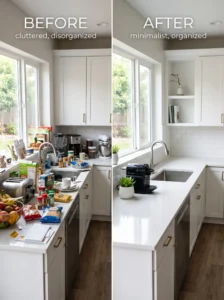
None of these require a renovation or a big purchase. They’re the changes that actually moved the needle for me:
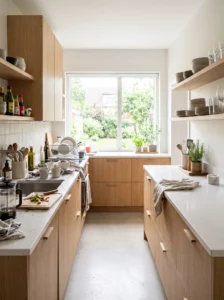
- Clear one full stretch of counter completely. Even 18 inches of empty counter resets how the whole kitchen reads.
- Use closed containers instead of open ones for pantry items — visible labels and mismatched packaging add more noise than people expect.
- Limit countertop decor to one item, max two. A single plant or bowl looks intentional; five small decorative pieces look forgotten.
- Take mail, keys, and random “landing zone” items out of the kitchen entirely. This single change cleared more visual clutter for me than any cabinet reorganization did.
- Match what you can’t hide. If appliances must stay out, similar colors or finishes make them read as a set rather than a pile.
A Quick Recap Before You Go Clean Again
- Dirty and cluttered are separate problems with separate fixes
- Visual noise comes from object variety — shape, color, and quantity — not from mess
- Small appliances left out are the most common hidden source of clutter
- More storage doesn’t fix clutter without a rule for what stays visible
- A simple three-second visual check can tell you more than a deep clean
Final Thoughts
The “clean but still cluttered” feeling isn’t a sign you’re failing at tidiness. It’s a sign your kitchen is asking your eyes to process too much at once, and no amount of scrubbing changes that math.
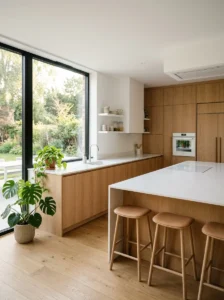
Once I understood this, I stopped chasing a spotless kitchen and started chasing a quiet one — fewer visible objects, fewer competing colors, more empty counter space. The cleaning routine barely changed. The feeling of the room changed completely.
A Few Questions People Ask Me About This
Q: Is kitchen clutter just a personality or habit issue? Not really. It’s much more about object density and visual variety than personal discipline. Two equally tidy people can have very different “clutter thresholds” simply based on how many objects and colors are visible at once in their space.
Q: Why does my kitchen feel messier than my bedroom even when both are equally tidy? Kitchens hold more unmatched objects — appliances, jars, utensils, packaging — packed into a smaller visible area than most bedrooms. That density alone makes kitchens more prone to feeling cluttered, even at the same actual tidiness level.
Q: Does owning fewer kitchen items automatically solve the problem? Owning less helps, but it isn’t the full answer. A kitchen with very few items can still feel cluttered if those items are mismatched and left out in the open. What matters more is what stays visible day to day.
Q: How much empty counter space is actually needed to feel “uncluttered”? There’s no universal number, but clearing even one continuous stretch — around a foot and a half — tends to noticeably calm down how a kitchen reads, based on what I’ve seen across different kitchen sizes.
Q: Will rearranging cabinets fix the cluttered feeling on its own? Usually not by itself. Cabinet rearranging helps with access and storage, but the cluttered feeling mostly comes from what’s sitting out on visible surfaces, not from what’s hidden behind cabinet doors.