

A bed without a headboard can look unfinished against a bare wall, but a headboard isn’t the only way to resolve that. Here’s what actually anchors a bed when there isn’t one.
A bed pushed against a bare wall, with nothing behind it, tends to look unresolved in a specific and recognizable way — not because the bed itself is wrong, but because the wall directly behind the head of the bed is one of the most visually prominent surfaces in the entire room, and an empty one there reads as an unfinished detail rather than a deliberate choice. A headboard is the most common fix, but it’s not the only one, and for a household without a headboard — whether by choice, budget, or a bed frame that simply doesn’t include one — there are several genuinely effective alternatives that solve the same visual problem.
Why the Wall Behind the Bed Matters So Much
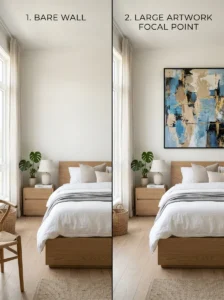
The wall behind the head of the bed is directly in the sightline from the bedroom door in most room layouts, and it’s also the backdrop for the bed itself, which is usually the room’s largest single piece of furniture. This combination — high visibility and proximity to the room’s visual anchor — is why an empty wall in this specific location reads as more unfinished than an equally empty wall elsewhere in the same room would.
A headboard solves this by giving the eye a defined edge where the bed “ends” against the wall, rather than the bed and the bare wall behind it reading as two separate, unrelated elements. Any solution to a missing headboard needs to accomplish this same basic function — creating a visual boundary and a sense of intentional composition at the head of the bed — even if it doesn’t look like a traditional headboard at all.
Wall-Mounted Alternatives Recreate a Headboard’s Visual Function
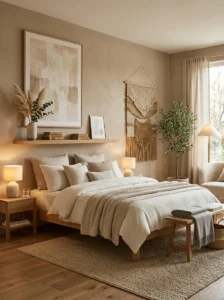
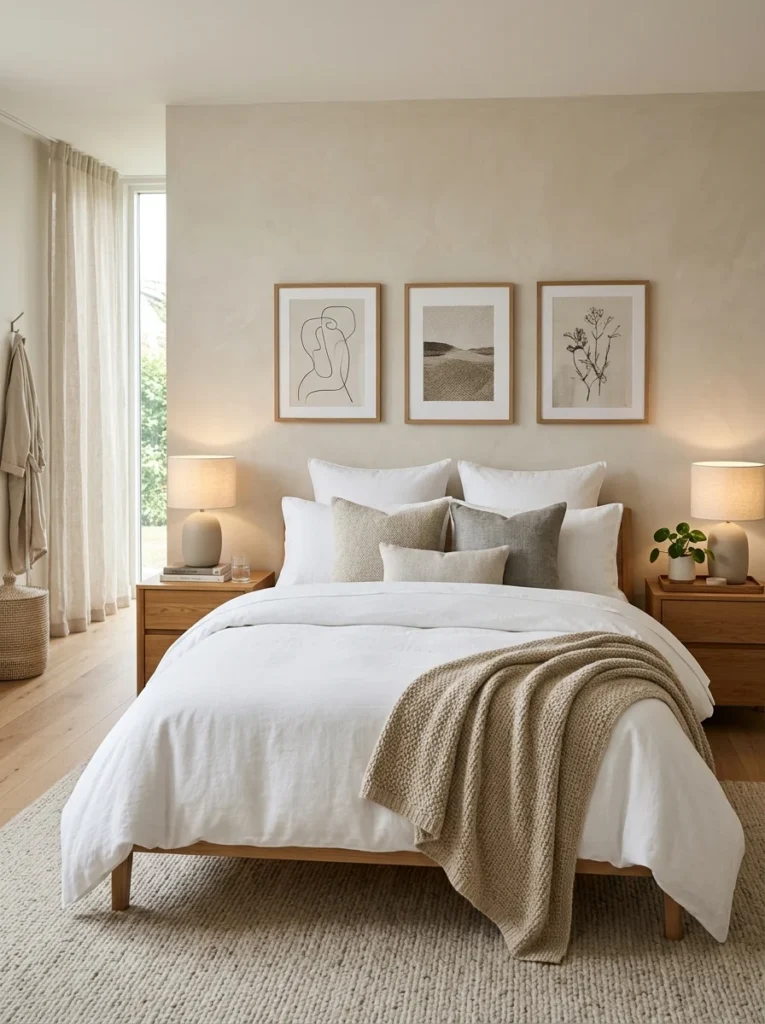
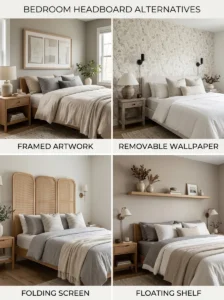
A large piece of art or a grouping of smaller framed pieces, sized appropriately to the width of the bed, is one of the most direct headboard substitutes, using the same scale principles covered elsewhere in this series regarding large living room walls — the art or grouping should occupy a meaningful portion of the wall width above the bed, roughly matching or slightly exceeding the bed’s own width, rather than a single small piece that reads as undersized against the bed’s larger scale.
A textile hung on the wall — a tapestry, a large woven piece, even a substantial piece of fabric mounted on a simple wood dowel — provides warmth and texture directly behind the bed at a lower cost than most furniture-based headboard alternatives, and it softens the wall in a way that flat art doesn’t, which can be a particularly good fit for a bedroom aiming for a warm, textural feel.
Wallpaper or paint, applied specifically to the wall behind the bed rather than the whole room, creates a defined accent zone that functions similarly to a headboard’s boundary-setting role, without requiring anything to be mounted on the wall at all. This is a particularly practical option in a rental, using the removable wallpaper approach covered elsewhere in this series, since it requires no drilling or permanent alteration and can be reversed at move-out.
A shelf mounted at headboard height, spanning the width of the bed, provides both the visual anchoring function and genuine practical storage or display space — for books, a lamp, small objects — that a traditional headboard doesn’t offer. This is one of the more functionally efficient alternatives on this list, since it solves the visual problem while adding a feature a standard headboard wouldn’t provide.
Layered Pillows Can Do More of This Work Than Most People Expect
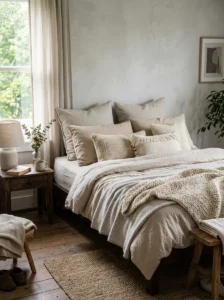
A generous arrangement of pillows — more than the minimal two sleeping pillows, built up in layers of varying size — creates visual height and fullness at the head of the bed that partially substitutes for a headboard’s presence, particularly when combined with one of the wall-based solutions above rather than relying on pillows alone.
This is a lower-cost, lower-commitment approach than most of the wall-mounted alternatives, and it’s worth trying as a first step even for a household planning to eventually add a more substantial headboard alternative, since it immediately improves the bed’s sense of completeness without any wall-mounted change, and can be layered with a wall solution later rather than needing to choose one approach exclusively.
Freestanding and Furniture-Based Alternatives
A tall dresser, bookshelf, or console positioned directly behind the bed — assuming adequate room depth — functions as a substantial, furniture-based headboard alternative, adding storage capacity in addition to the visual anchoring effect. This works particularly well in a room where the bed isn’t against an exterior or load-bearing wall consideration, and where the household could use the additional storage this approach provides regardless of the headboard question.
A folding screen or room divider placed behind the bed provides a freestanding alternative that doesn’t require any wall mounting at all, which is a particularly useful option for a rental or for a household that wants full flexibility to rearrange the room without needing to address wall-mounted elements first.
Floating nightstands or wall-mounted sconces flanking the bed, even without a headboard between them, create a sense of framing around the head of the bed that partially accomplishes the same visual anchoring a headboard provides, using symmetry and flanking placement rather than a single central element to draw the eye to the bed as an intentional composition.
Lighting Specifically Can Anchor the Space Without Any Physical Headboard Substitute
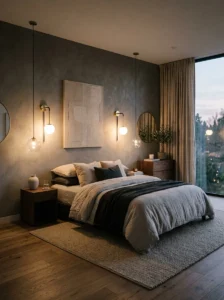
As covered in more detail elsewhere in this series regarding bedroom lighting generally, wall-mounted sconces or pendant lights flanking the bed serve a genuine functional lighting purpose while also contributing meaningfully to the sense that the head of the bed is a deliberately composed area, not simply a bed pushed against an empty wall. This is a particularly efficient solution for a household that needs to improve bedside lighting anyway, since it solves two problems — inadequate reading light and a visually unresolved wall — with a single addition.
A single statement light fixture centered above the bed — a pendant, an oversized sconce — can function similarly to a single piece of centered art, drawing the eye to a considered focal point directly above the headboard-less bed.
Choosing an Approach Based on Commitment Level and Room Constraints
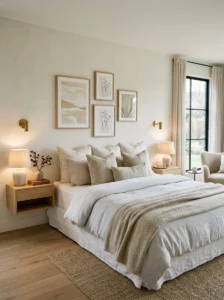
For a rental or a household uncertain about long-term plans, textile hangings, removable wallpaper, layered pillows, and a folding screen are the lowest-commitment options, none of which require permanent alteration or a large furniture purchase, and all of which can be adjusted or removed easily as needs change.
For a household ready to invest in a more permanent solution, a substantial art grouping, a mounted shelf, or furniture positioned behind the bed provide more lasting, functionally richer alternatives, some of which add genuine storage or display capacity that a traditional headboard wouldn’t have provided in the first place.
Combining more than one approach — layered pillows with a piece of art above, or a shelf with flanking sconces — often produces a more complete result than any single alternative on its own, in the same way a traditional headboard is rarely the only element addressing the head of the bed in a fully styled bedroom; it’s usually paired with bedside lighting, pillows, and sometimes art above it regardless.
Key Takeaways
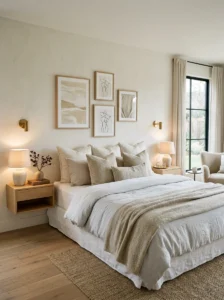
- The wall behind the head of the bed is unusually visible — directly in the sightline from the door and immediately behind the room’s largest furniture piece — which is why an empty wall there reads as more unfinished than an equally empty wall elsewhere in the room
- Art, a tapestry, an accent paint or wallpaper zone, or a mounted shelf can all recreate a headboard’s visual boundary-setting function without requiring an actual headboard
- Layered pillows, built up beyond the minimal sleeping set, add visual height and fullness at low cost and work well as an immediate step or in combination with a wall-based solution
- Furniture positioned behind the bed — a tall dresser, bookshelf, or console — provides a substantial headboard alternative while adding genuine storage capacity
- Flanking sconces or nightstands create a sense of intentional framing around the bed even without a central headboard element, and serve a real lighting function at the same time
- Lower-commitment options — textiles, removable wallpaper, pillows, a folding screen — suit a rental or an undecided household, while furniture and mounted solutions suit a household ready to invest more permanently

Frequently Asked Questions
What’s the cheapest way to make a bed without a headboard look finished? Layering pillows well beyond the minimal sleeping set is typically the lowest-cost immediate improvement, and combining it with a single piece of art or a length of fabric hung on the wall behind the bed extends that effect further without requiring furniture-level investment. Both options are also fully reversible, which suits a rental or an undecided household well.
Can I use art instead of a headboard, or does it look incomplete without something physical behind the bed? Art alone works well as a headboard substitute, provided it’s sized appropriately — roughly matching or slightly exceeding the bed’s width — rather than a single small piece that reads as undersized against the bed’s larger scale. This is one of the more common and effective headboard alternatives, and it doesn’t require anything physically installed at the head of the bed itself.
Is it worth mounting a shelf behind the bed instead of buying a headboard? It’s a strong option worth considering, since it accomplishes the same visual anchoring function as a headboard while adding genuine storage or display space that a traditional headboard doesn’t provide. It requires wall mounting, so it’s a better fit for a household not concerned about rental restrictions or already comfortable installing wall-mounted furniture.
Do flanking sconces really help if there’s nothing between them at the head of the bed? Yes — symmetrical flanking elements create a sense of intentional framing around the bed on their own, drawing the eye to the head of the bed as a considered composition even without a central headboard-like element between them. They also serve a genuine bedside lighting function, which makes them a particularly efficient choice for a household that needs better reading light regardless of the headboard question.
Should I combine multiple headboard alternatives, or pick just one? Combining approaches often produces a more complete result than relying on a single element alone, in the same way a traditional headboard is typically paired with pillows, bedside lighting, and sometimes art above it in a fully styled bedroom. Starting with a lower-cost option like layered pillows, then adding a wall-based element over time, is a reasonable way to build toward a combined approach gradually.