

The right kitchen countertop isn’t the most beautiful one — it’s the one that fits how you actually cook, clean, and live. Here’s how to make that distinction before spending thousands.Theres a version of this decision that goes wrong in a predictable way. Someone falls in love with Calacatta marble in a showroom, installs it, and within eight months is blotting wine drops, avoiding citrus directly on the surface, and treating their primary cooking counter like a fragile artifact rather than a working tool. The marble is as beautiful as advertised. It just wasn’t the right choice for that specific household, and no one asked the right questions before the check was written.
The countertop industry is excellent at presenting every material in its best light — sealed, fresh, photographed under flattering conditions. What it’s less forthcoming about is how each material behaves two years into daily life with a family that actually cooks, has kids, leaves wet things on surfaces, and doesn’t always remember to use a cutting board.
This article is about matching material to lifestyle first, and worrying about aesthetics second — in that order, not the other way around.
Before Looking at a Single Sample, Ask These Questions
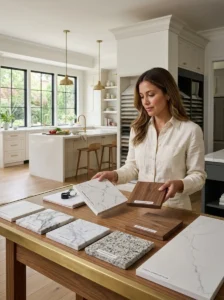
The right countertop for someone who cooks elaborate meals five nights a week is probably not the right countertop for someone who mostly reheats takeout and uses the kitchen primarily as a social space. The right countertop for a household with young children is not the right countertop for a couple whose kitchen sees light use and deliberate care.
Before walking into any showroom or clicking through any material gallery, be honest about the following:
How often do you actually cook from scratch? Not how often you intend to, but how often you do. A heavy cook generates heat, impact, moisture, and staining risk every day. A light cook generates them rarely.
How careful are you with surfaces when in the middle of cooking? Some people naturally protect counters — using cutting boards always, wiping spills immediately, setting hot pans on trivets. Others cook in a focused, somewhat chaotic way where the counter takes whatever the cooking session requires. Neither is wrong; they just require different materials.
Do children use this kitchen unsupervised? Young children are hard on surfaces in ways that are impossible to fully manage — markers left on counters, acidic juice spilled and not wiped, things dropped from height.
How much time do you want to spend on maintenance? Some materials require regular sealing, careful cleaning products, and deliberate protection. Others require nothing beyond normal cleaning. If maintenance feels like a chore rather than something you’d genuinely do, this eliminates several otherwise attractive options immediately.
What’s the realistic budget, including installation? Countertop material costs are rarely what surprises people — it’s the fabrication and installation, which can equal or exceed the material itself depending on complexity.
The Materials, Honestly Assessed
Quartz (Engineered Stone)
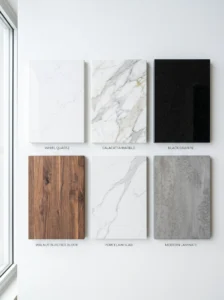
What it is: crushed natural quartz combined with resin binders and pigment, manufactured in consistent slabs.
Who it genuinely suits: Most households. Quartz is the closest thing to an all-lifestyle countertop available because it’s non-porous (no sealing required, ever), highly stain-resistant, and consistent in color and pattern throughout the slab. It handles acidic foods, wine, and coffee without reacting. It doesn’t require the ongoing care that natural stone does.
What it doesn’t do well: Quartz is not heat-proof — placing a hot pan directly on it can crack or discolor the resin binders. It’s also less “alive” visually than natural stone; the patterns are manufactured to be consistent, which means they lack the subtle variation and movement that makes marble and granite genuinely beautiful in person.
The honest summary: Quartz is the practical choice, which is precisely why it’s also the most common choice. It suits heavy cooks, families with children, people who want a maintenance-free surface, and anyone who prefers reliability over drama.
Marble
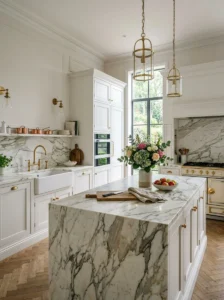
What it is: natural metamorphic stone, formed under pressure, characterized by veining and significant variation between slabs.
Who it genuinely suits: Light to moderate cooks with a genuine appreciation for natural material and a willingness to manage maintenance. The people who are happiest with marble long-term are those who view the patina it develops — the small etches, the acquired character — as part of the appeal rather than damage. People who will be distressed by an etch mark from a glass of orange juice left too long will not enjoy living with marble.
What it doesn’t do well: Marble is calcium carbonate, which reacts chemically with any acidic substance — citrus, vinegar, wine, tomato. This reaction creates etch marks — dull patches where the surface has been chemically altered — which are different from stains and cannot be cleaned away, only polished out or accepted. It also stains from oils and some foods if not sealed and if spills aren’t wiped promptly.
The honest summary: Marble is genuinely one of the most beautiful countertop materials available. It is also the one requiring the most behavioral adjustment and ongoing maintenance. It suits kitchens where the countertop is partly a design statement and partly a functional surface — not kitchens where the counter is battered through intensive daily cooking.
Granite
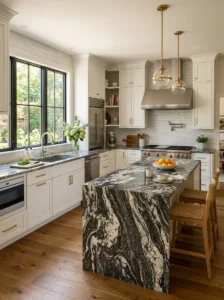
What it is: natural igneous stone, harder than marble, with significant variation in pattern and color between slabs.
Who it genuinely suits: People who want natural stone character with meaningfully better durability than marble. Granite is harder, less porous, and considerably more resistant to etching. It requires periodic sealing — typically once a year for a countertop under regular use — but tolerates kitchen life more forgivingly than marble does.
What it doesn’t do well: The color and pattern variation in granite is not always an asset — some slabs are visually quiet and elegant, others are busy in ways that fight with other elements in the room. Unlike quartz, you’re choosing a specific slab, not a consistent product, which means the sample in the showroom may look meaningfully different from the slab you actually receive.
The honest summary: Granite sits between marble and quartz on the maintenance spectrum — more demanding than quartz, more forgiving than marble. It suits moderate-to-heavy cooks who want natural stone without marble’s sensitivity, and who are willing to seal it annually.
Butcher Block
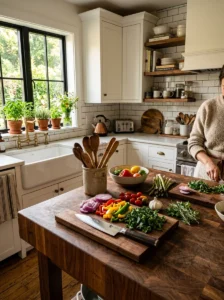
What it is: thick sections of end-grain or edge-grain wood laminated together, typically maple, walnut, or oak.
Who it genuinely suits: People who cook frequently and want a surface that’s gentle on knife edges and warm in character. Butcher block is the most tactilely satisfying countertop available — it has warmth, it absorbs sound differently than stone, and it can be refinished if it develops significant damage, which no stone surface can.
What it doesn’t do well: Wood and water are a long-term problem if moisture is allowed to penetrate — warping, cracking, and bacterial concerns around a sink where the wood stays consistently wet. Butcher block adjacent to a sink requires more diligent sealing and care than almost any other use case for wood.
The honest summary: Best used as a section rather than the full counter — a butcher block island or a prep section adjacent to the main cooking area, with stone or quartz covering the sink and high-moisture zones. As a complete countertop solution, it demands a level of maintenance that most households underestimate at installation.
Porcelain Slab
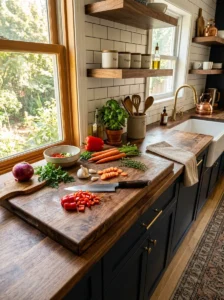
What it is: large-format fired porcelain tiles manufactured in slab form, often mimicking marble, concrete, or stone.
Who it genuinely suits: People who want the look of natural stone with significantly better performance. Porcelain is non-porous, UV-stable, scratch-resistant, heat-tolerant to a higher threshold than quartz, and doesn’t require sealing. It’s one of the most technically durable countertop materials available.
What it doesn’t do well: Porcelain slabs are brittle at the edges, which means edge chipping is a vulnerability that marble and granite — both harder stones — don’t share to the same degree. Thin porcelain slabs in particular require careful fabrication and handling. The visual result, while often convincing at distance, can read as slightly different from natural stone at close range to an attentive eye.
The honest summary: Increasingly popular for good reason — porcelain delivers the aesthetic of natural stone with performance characteristics closer to engineered quartz. Worth serious consideration for any household that wants the visual of marble with none of the maintenance.
Laminate
What it is: a paper or fabric layer bonded to a particleboard or MDF core under high pressure, finished with a protective layer.
Who it genuinely suits: Budget-conscious households, rental properties, or any situation where the countertop is a temporary or functional-priority solution rather than a long-term design investment.
What it doesn’t do well: Laminate edges show wear earlier than the surface, particularly around sinks and high-contact zones. It cannot be refinished when damaged. Heat resistance is poor — a hot pan placed directly on laminate causes permanent damage immediately.
The honest summary: Laminate has improved significantly in recent years — high-quality laminate in matte finishes reads considerably better than the shiny versions that defined its reputation. As a budget or temporary solution, it’s entirely functional. As a long-term primary countertop in a kitchen where cooking matters, the limitations show up faster than the price difference justifies avoiding better materials.
Concrete
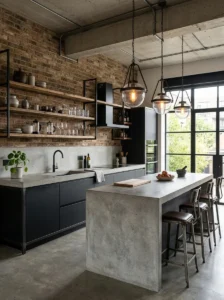
What it is: poured or precast concrete slabs, typically custom-fabricated for the specific kitchen.
Who it genuinely suits: People who want a genuinely distinctive, handcrafted countertop and are willing to manage the care and accept the character that comes with natural concrete aging.
What it doesn’t do well: Concrete is porous and prone to both staining and cracking without proper sealing and care. It’s also among the most expensive options when properly fabricated and sealed, which often surprises people who associate concrete with cheapness in other contexts. The visible variations, hairline cracks, and inconsistencies that give concrete its character are features to some homeowners and flaws to others.
The honest summary: A highly personal choice that suits specific aesthetics and specific owners. Not recommended as a primary material for households prioritizing practicality or resale value.
The Decision Framework in Plain Terms
You cook heavily, have kids, or want minimal maintenance: Quartz. Full stop.
You want natural stone character and will seal annually but cook with reasonable care: Granite.
You love marble genuinely and will accept its requirements as part of the relationship: Honed marble in low-contrast white, which shows etching less than polished or heavily veined versions.
You want natural stone performance without natural stone sensitivity: Porcelain slab.
You want warmth, a great knife surface, and a beautiful prep area: Butcher block for a section; pair it with quartz or porcelain at the sink.
Budget is the primary constraint: High-quality matte laminate now, with a plan to upgrade when circumstances change.
Key Takeaways
- Material choice should follow lifestyle assessment, not the other way around
- Quartz is the most reliable all-lifestyle choice; its limitations are visual rather than practical
- Marble’s beauty is real, but so are its behavioral requirements — it suits specific owners, not all owners
- Granite occupies a genuine middle ground between marble and quartz in both beauty and durability
- Porcelain slab is underused and underrated — it performs better than marble while often looking nearly identical
- Butcher block works best as a zone rather than a complete countertop solution
- Heat tolerance, stain resistance, sealing requirements, and edge durability are the four practical variables that matter most in daily life
Frequently Asked Questions
Is it worth spending extra on thicker countertop slabs? Thickness affects the edge profile options available and how the countertop reads visually — a thicker slab reads as more substantial and premium. Functionally, for most materials, thickness above a standard three-quarter inch or one-and-a-quarter inch doesn’t change performance meaningfully. The upgrade is primarily aesthetic and is worth it if the visual weight matters to the overall design.
How often does quartz actually need to be replaced? Rarely. A quality quartz countertop installed correctly should last several decades under normal use. The vulnerabilities — cracking from direct heat, chips from heavy impact at the edge — are avoidable with reasonable care. It’s not an indefinite material, but a reasonable planning horizon is twenty or more years.
Can you put a hot pan on granite? Granite can handle heat better than quartz — natural stone is not affected by the resin-burning issue that quartz has — but repeated thermal shock from very hot pans can over time cause hairline cracks. The habit of using a trivet protects any countertop material and extends its life regardless of type.
Does the countertop choice significantly affect home resale value? Countertop material matters to buyers at the showing stage — it’s one of the first things visible in a kitchen. Quartz and natural stone consistently read as upgrades to buyers. Laminate does not, regardless of condition. The actual return on countertop investment varies significantly by market, but in most markets, a quality countertop makes the kitchen easier to sell at a stronger price.
What’s the single most regretted countertop choice? Based on what homeowners most commonly report regretting: white polished marble in a kitchen used for real cooking. The etching and staining that develop quickly under active use frequently distress owners who loved the look but weren’t prepared for the reality. Honed marble, which shows etching less dramatically, and quartz in a marble-look pattern, which doesn’t etch at all, are both worth considering for anyone who loves the aesthetic but cooks seriously.