

An accent wall can make a bedroom feel considered and dimensional, or it can make it feel busier and smaller. The difference comes down to which wall, what treatment, and the room’s actual proportions.
An accent wall is one of the more polarizing choices in bedroom design — genuinely transformative in the right room, and a specific, identifiable mistake in the wrong one. The difference between these two outcomes isn’t really about taste or which color is chosen. It’s about a handful of concrete factors — which wall is selected, the room’s actual proportions, and what’s already competing for visual attention — that determine whether an accent wall reads as a considered design decision or as a room that feels busier and smaller than it did with four matching walls.
The Headboard Wall Is Almost Always the Right Choice
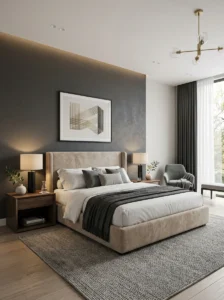
The wall behind the head of the bed is the default and generally correct choice for a bedroom accent wall, for the same reason it’s the wall most in need of visual attention when there’s no headboard at all, covered elsewhere in this series — it’s the wall most visible from the room’s entry point and the immediate backdrop to the bed, the room’s largest and most visually significant piece of furniture.
An accent wall anywhere other than behind the headboard tends to compete with the bed for visual primacy rather than supporting it, which is part of why an accent wall on a side wall or the wall opposite the bed often reads as slightly arbitrary — attention-grabbing in its own right, but disconnected from the room’s actual visual anchor. There are exceptions — a wall with a genuinely compelling architectural feature, or a room where the bed isn’t the dominant furniture piece for some other reason — but as a default rule, the headboard wall is the correct starting point for nearly every bedroom.
Room Proportion Determines Whether an Accent Wall Helps or Hurts
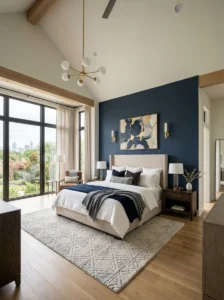
A darker or bolder accent wall recedes visually, which means it can make a wall — and by extension the room in that direction — feel like it’s set further back than it physically is, an effect that’s genuinely useful in a room that feels too narrow or too boxy, and counterproductive in a room that’s already small in every direction.
In a small bedroom, particularly one with low ceilings, a dark or busy accent wall can make the room feel more enclosed and smaller rather than more dimensional, since there isn’t enough surrounding neutral space for the accent to read as a deliberate contrast rather than simply more visual density in an already tight room. This is the most common single reason an accent wall fails: it’s applied to a room too small or too visually busy already to support the additional contrast without feeling cramped.
In a room with a low ceiling specifically, a full accent wall that extends to the ceiling and stops there — rather than being paired with a lighter ceiling color — reinforces the sense of a lower ceiling, since the eye reads the wall-to-ceiling color transition as the room’s actual height boundary. A lighter ceiling, even in a room with a bold accent wall, helps counteract this specific effect.
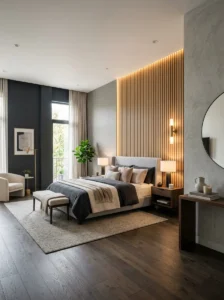
A genuinely large or high-ceilinged bedroom can support a more dramatic or darker accent wall without the enclosing effect that the same treatment produces in a small room, since there’s enough surrounding volume for the eye to read the accent as a considered contrast rather than a wall closing in on the space.
An Accent Wall Needs Room to Actually Be Seen
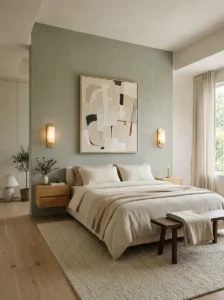
An accent wall crowded with a large amount of art, a full gallery wall, heavy furniture, or a large mirror competing for the same visual space often fails to register as an accent wall at all — it simply becomes a busier wall, with the color choice lost among everything else occupying the same surface. This is a common and avoidable mistake: choosing a bold accent wall and then treating it the same as any other wall in terms of what’s hung or placed against it, rather than allowing the color itself room to be the wall’s primary visual statement.
The most effective accent walls generally carry a restrained amount of additional visual weight — the headboard and bed itself, perhaps a single piece of art or a pair of flanking sconces, but not a dense gallery wall or heavy furniture competing directly with the color for attention. This is a direct parallel to the negative-space principle covered elsewhere in this series regarding shelving and coffee tables: the accent wall needs some visual breathing room to actually function as an accent, rather than being buried under competing visual elements.
Texture Accent Walls Solve a Different Problem Than Paint Accent Walls
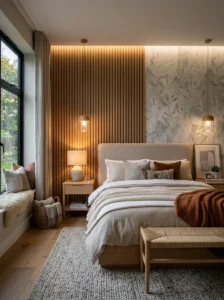
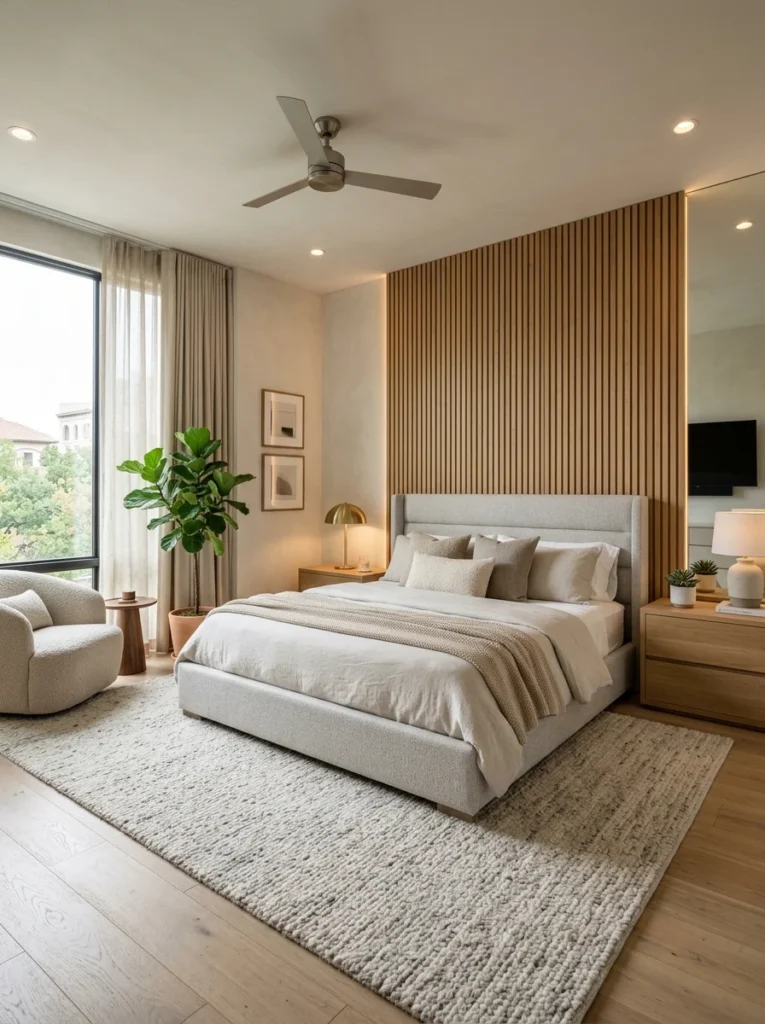
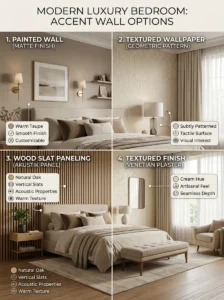
A textured treatment — wood slat paneling, a woven grasscloth wallpaper, a textured plaster finish — accomplishes a somewhat different goal than a paint-only accent wall, adding dimensional depth and tactile interest rather than primarily a color contrast. This tends to work well in a bedroom aiming for warmth and richness rather than primarily a bold color statement, and it has a practical advantage paint doesn’t: texture reads as considered and intentional even in a relatively neutral or muted color, which sidesteps some of the color-commitment risk of a bold paint accent wall.
Wood slat paneling specifically has become a particularly common bedroom accent wall treatment, in part because it provides the visual weight and dimensionality of an accent wall while remaining in a neutral or wood-tone palette that doesn’t carry the same risk of feeling dated on the same timeline a trend-forward paint color might, a consideration covered in more detail elsewhere in this series regarding sofa color longevity, which applies to accent wall treatments in a similar way.
Wallpaper accent walls occupy a middle ground between paint and true dimensional texture — providing pattern and sometimes a printed or embossed textural quality without the full commitment or cost of a paneled or plastered treatment, and removable wallpaper options, covered elsewhere in this series in the context of rentals, make this a genuinely accessible option even for a household that can’t paint or install permanent treatments.
When an Accent Wall Genuinely Doesn’t Work
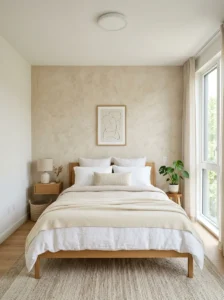
A bedroom with an already-busy visual environment — a bold patterned bedding set, extensive art, a heavily patterned rug — is generally not well served by adding a bold accent wall on top of everything else already competing for attention, since the room ends up without a clear visual hierarchy, and everything reads as equally loud rather than one element reading as a considered focal point.
A small, low-ceilinged room, as covered above, is the most common case where an accent wall works against the room’s proportions rather than for them, and a household in this situation is often better served by a lighter, more restrained accent — a slightly different but still light tone, or a textural rather than a dark color-based treatment — than by the more dramatic accent wall treatments that work well in larger rooms.
Choosing the wrong wall — anything other than the headboard wall, absent a specific architectural reason to choose otherwise — is a common and avoidable failure, since it tends to create a secondary visual focal point that competes with, rather than supports, the bed as the room’s primary anchor.
Key Takeaways
- The headboard wall is almost always the correct choice for a bedroom accent wall, since it’s the room’s most visible surface and the direct backdrop to the bed, the room’s primary furniture anchor
- Darker or bolder accent walls can help a room feel more dimensional in a larger or higher-ceilinged bedroom, but tend to make an already small or low-ceilinged room feel more enclosed rather than more spacious
- A lighter ceiling color helps counteract the height-reducing effect a full-height dark accent wall can create in a low-ceilinged room
- An accent wall needs some visual breathing room — restrained art and furniture rather than a dense gallery wall or heavy competing elements — to actually register as an accent rather than simply a busier wall
- Textured treatments like wood paneling or wallpaper accomplish a different goal than paint, adding dimensional richness with less color-commitment risk and often less risk of feeling dated on a fast timeline
- An accent wall generally fails in an already visually busy room, a small low-ceilinged room without a lighter ceiling to compensate, or when it’s placed on a wall other than the headboard wall without a specific architectural reason
Frequently Asked Questions
Is the headboard wall always the best choice for a bedroom accent wall? It’s the correct default in nearly every case, since it’s the room’s most visible wall and the direct backdrop to the bed. Exceptions exist mainly where a different wall has a genuine architectural feature — an alcove, an interesting window, exposed brick — that makes a stronger case for being the room’s focal point instead.
Can a small bedroom have an accent wall, or does it always make the room feel smaller? A small bedroom can support an accent wall, but it generally needs to be a lighter or more restrained treatment — a subtle tonal shift, a textural finish rather than a dark, bold color — combined with a lighter ceiling color, rather than the more dramatic, darker accent wall treatments that work well in larger or higher-ceilinged rooms.
Should I choose paint or wallpaper for a bedroom accent wall? Both work well, and the choice depends on the goal — paint is generally lower cost and lower commitment for a pure color statement, while wallpaper or textured treatments add pattern or dimensional richness that paint alone doesn’t provide, and removable wallpaper specifically offers a lower-commitment, rental-friendly path to a similar effect.
Is it a mistake to put a lot of art on an accent wall? It can undercut the accent wall’s effect, since a densely covered wall reads primarily as busy rather than as a deliberate color or texture statement. A more restrained amount of art or decor on an accent wall — or none beyond the bed and its immediate surroundings — generally lets the wall actually function as an accent rather than getting visually buried.
Does an accent wall look dated faster than a fully neutral bedroom? It depends heavily on the specific color or treatment chosen — a highly trend-forward paint color carries similar dating risk to any trend-forward color choice covered elsewhere in this series regarding sofa color, while a more textural, neutral-toned treatment like wood paneling tends to hold up over a longer timeline than a bold, trend-driven paint color would.