



Window treatments are usually chosen for privacy and looks, but they’re doing several other functional jobs at the same time — some of which matter more than either of those two. Here’s the full list.
Privacy is the most commonly cited reason for choosing window treatments, and it’s a genuinely important one, but it’s also just one of several distinct functions curtains, shades, and blinds perform simultaneously — functions that are worth understanding individually, since a treatment chosen purely for privacy or purely for looks often ends up underperforming on the other jobs it’s also being asked to do. Understanding the full range of what window treatments actually accomplish makes it considerably easier to choose the right type for a specific room’s actual needs, rather than defaulting to whatever looks appropriate without checking whether it functions well for the room’s other real requirements.
Light Control Is a Spectrum, Not a Single Function
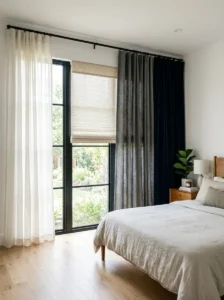
“Blocking light” undersells what window treatments actually do with light, since there’s a meaningful range between fully sheer, light-filtering, room-darkening, and true blackout, and each level suits different rooms and different times of day differently. A living room generally benefits from more flexible, moderate light control — enough privacy and glare reduction without eliminating natural light during the day — while a bedroom, as covered in more detail elsewhere in this series regarding sleep-supportive lighting, often benefits from genuine blackout capability specifically for the sleep period, alongside more moderate light-filtering for daytime use.
Layering — a sheer or light-filtering treatment paired with a heavier or blackout layer on a separate track — is the most common solution for a room that needs to serve both ends of this spectrum, covered in more detail elsewhere in this series regarding bedroom curtains specifically, but the same layering principle applies to any room where daytime light needs and evening or nighttime darkness needs genuinely differ.
Insulation and Temperature Regulation Are a Real, Measurable Function

Windows are typically the least insulated part of a room’s envelope, and heavier window treatments — particularly lined curtains, cellular shades, and other treatments specifically designed with an insulating air pocket or dense fabric layer — provide a real, measurable reduction in heat loss during cold weather and heat gain during hot weather, functioning as an additional insulating layer over the window itself.
This matters most in older homes with less efficient windows, and in rooms with a particularly large window-to-wall ratio, where the window is doing more of the work in the room’s overall temperature regulation than in a room with more modest window coverage. A household in this situation benefits from weighing a treatment’s insulating properties alongside its light-control and privacy functions, rather than choosing purely based on appearance, since the insulating difference between a thin, unlined treatment and a heavier, properly lined or cellular one can be genuinely significant to both comfort and energy costs.
Sound Dampening Is a Secondary but Real Benefit

As touched on elsewhere in this series regarding hard surfaces and sound reflection, windows — being hard, flat, and often large — contribute to sound reflecting around a room, and heavier window treatments provide some genuine sound-dampening benefit, absorbing and softening sound in a way a bare window doesn’t. This is a secondary rather than primary function of most window treatments, but it’s a real, additive benefit in a room that’s already dealing with sound reflection issues from other hard surfaces, and it’s worth factoring in as one more reason heavier, more substantial treatments outperform thin, minimal ones in a room where acoustic comfort matters.
UV Protection Preserves Furniture, Flooring, and Art

Direct sunlight through an unprotected window causes real, cumulative fading and material degradation to flooring, upholstery, art, and other furnishings over time — a slow, easy-to-overlook process that becomes obvious only once furniture or flooring shows a visible, uneven fade pattern that can’t be reversed. Window treatments, even relatively sheer ones, block a meaningful portion of the UV exposure responsible for this fading, which is a genuinely protective function separate from any of the room’s light-control, privacy, or aesthetic considerations.
This matters most for a room with significant direct sun exposure for extended periods of the day, and for furnishings, flooring, or art of real value or sentimental significance, where preventing UV-related fading is a meaningful, ongoing benefit that’s easy to overlook when window treatments are chosen purely for their light-control or decorative function.
Softening Architecture and Framing a View

A window treatment adds softness and texture to what’s otherwise one of the hardest, flattest surfaces in most rooms — the glass and often the surrounding trim — contributing to the layered texture covered in more detail elsewhere in this series regarding what separates a calm, warm room from a cold, clinical one. Even a room with an otherwise appealing architectural window benefits from this softening effect, since fabric and texture provide a contrast to the window’s hard materials that a bare window, however well-proportioned, doesn’t offer on its own.
Window treatments also frame a view — literally, in the way curtains create a visual border around what’s visible through the window, drawing attention to a good view and, conversely, providing a way to selectively obscure or soften an unappealing one. A treatment that can be adjusted to reveal a pleasant view while providing privacy or light control at other times offers more functional flexibility than a fixed treatment that either fully covers or fully exposes the window at all times.
Room Proportion and Perceived Height, Covered Elsewhere but Worth Repeating Here
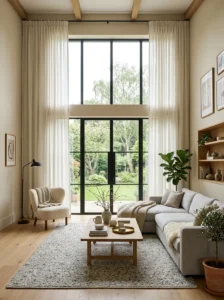
As covered in more detail elsewhere in this series regarding luxurious bedroom curtains specifically, where a treatment is mounted relative to the window frame significantly affects a room’s perceived proportions — mounted higher and wider than the window frame itself, a treatment makes both the window and the room appear larger, an effect that applies to any room’s window treatments, not just a bedroom’s. This is worth remembering as a genuine functional consideration, not purely a decorative one, since it affects how spacious and well-proportioned an entire room feels, independent of the treatment’s fabric, color, or style.
Choosing a Treatment Based on Which Functions Actually Matter for a Specific Room
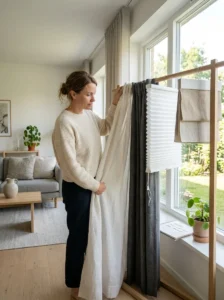
A room facing a busy street at eye level has different priority functions than a room with abundant privacy but strong afternoon sun, and a room prone to temperature swings has different priorities than a well-insulated, climate-controlled space — identifying which of these functions genuinely matters most for a specific room, rather than defaulting to whatever treatment looks most appealing, produces a more functionally successful choice.
A practical approach: rank the room’s actual priority functions — privacy, light control for sleep or glare, insulation, sound dampening, UV protection, aesthetic softening — before shopping, since a treatment excellent at one function but weak at another that the room actually needs will underperform regardless of how well it satisfies the priority the household focused on initially.
Key Takeaways

- Light control exists on a spectrum from sheer to true blackout, and most rooms benefit from a layered approach rather than a single treatment trying to serve every light-control need at once
- Heavier, properly lined or cellular window treatments provide real, measurable insulation, reducing heat loss and heat gain — a meaningful benefit in older homes or rooms with a large window-to-wall ratio
- Window treatments provide genuine sound-dampening as a secondary benefit, softening the reflective quality that bare, hard window surfaces contribute to a room’s acoustics
- Even relatively sheer treatments block meaningful UV exposure, protecting furniture, flooring, and art from the cumulative, hard-to-reverse fading that direct sunlight causes over time
- Treatments soften a room’s hardest architectural surfaces and can be used to frame or selectively reveal a view, functions separate from and additional to privacy or pure decoration
- Mounting height and width relative to the window frame affects a room’s perceived proportions in any room, not only bedrooms, and is worth treating as a functional decision rather than a purely aesthetic one

Frequently Asked Questions
Do window treatments actually help with a room’s temperature, or is that overstated? It’s a real, measurable effect, particularly with heavier lined curtains or cellular shades specifically designed for insulation, and particularly relevant in older homes or rooms with large windows relative to their wall area. The insulating benefit is generally secondary to light control and privacy in most people’s decision-making, but it’s a genuine functional consideration worth factoring in, especially for a room with noticeable temperature swings.
Can sheer curtains actually protect furniture from sun fading, or do I need heavier fabric? Even relatively sheer treatments block a meaningful portion of UV exposure, though heavier or specifically UV-protective linings block more. For a room with significant direct sun exposure and furnishings or flooring of real value, a heavier or specifically treated lining provides more protection than a very light, minimally filtering sheer fabric alone.
Should every room have layered window treatments, or is that only necessary for bedrooms? Layering is most essential in rooms where light-control needs genuinely differ significantly between daytime and nighttime use — bedrooms being the clearest example, given the sleep-specific blackout need. Other rooms can often be well served by a single, well-chosen treatment if their light-control needs are more consistent throughout the day, though layering remains a reasonable option anywhere flexibility is valued.
Does the height I mount curtains at really affect anything besides the room’s looks? The mounting height and width do have a genuine functional benefit beyond appearance — curtains mounted higher and wider than the window frame can be fully opened without covering any part of the window, maximizing daytime light, while curtains mounted at the frame’s exact width inevitably block some portion of the window even when fully open.
How do I decide which window treatment function matters most for my specific room? Consider the room’s actual conditions directly — how much direct sun it gets, whether it faces a street or neighbors at eye level, whether temperature swings are a noticeable issue, whether the room needs genuine darkness at certain times. Ranking these actual priorities before shopping, rather than choosing based on appearance alone, leads to a treatment that performs well for the specific functions that room actually needs.