

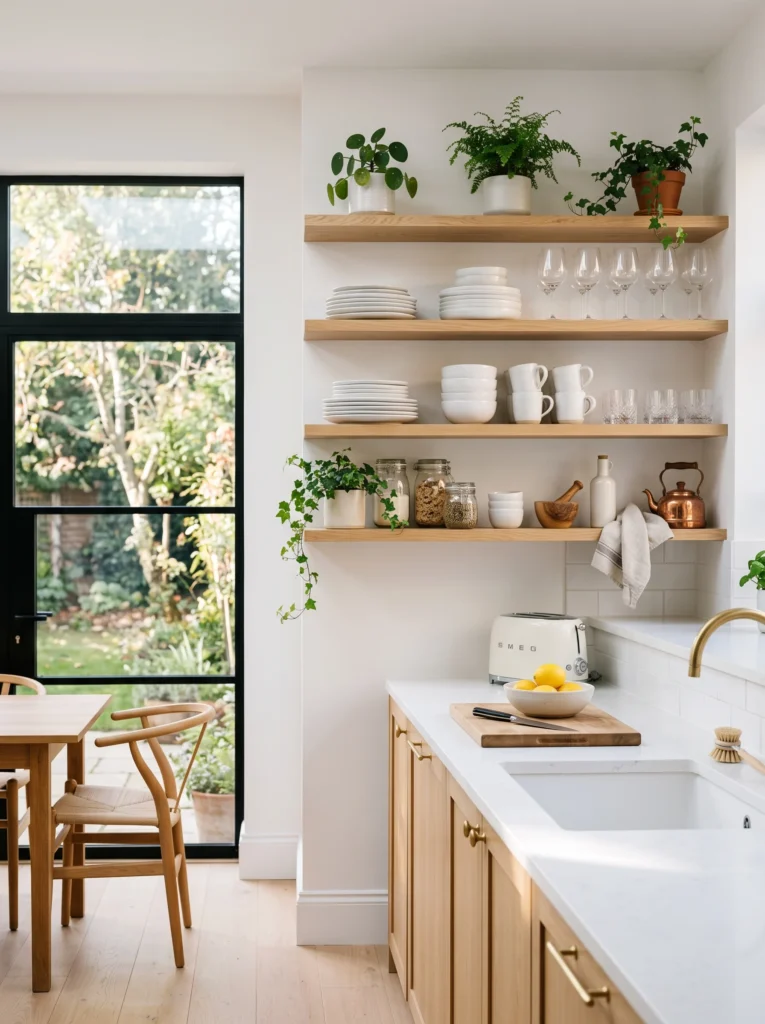
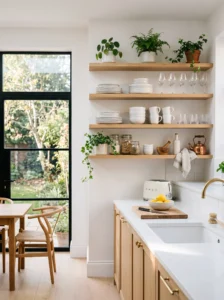
Open shelving looks magazine-perfect in photos — clean lines, pretty plates, a few trailing plants. But live with it for six months and a different story shows up: dust on your mugs, grease film on your favorite bowls, and a constant pressure to keep everything “styled.”
I’ve spent years working around kitchen renovations, helping homeowners weigh cabinets against shelves, and the gap between the Pinterest version and the lived-in version is bigger than most people expect. This article walks through what actually happens once the contractor leaves and real life moves back in.
Why Open Shelving Looks So Good in Photos (and Different in Real Life)
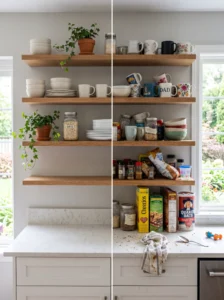
Design photos are staged. Someone arranged those dishes five minutes before the shutter clicked, and nobody was reaching for a cereal bowl at 7 a.m. while running late for work.
In real life, shelves get used constantly. Items get pulled, shoved back, stacked unevenly, and mixed with whatever you bought last weekend. The “effortless” look in photos actually requires effort — ongoing, repeated effort — to maintain.
The Styling Tax
Open shelving has what I’d call a styling tax: a small but real amount of daily mental energy spent on whether things look okay, not just whether they’re put away. Closed cabinets don’t charge this tax. You shut the door and you’re done.
For naturally tidy people, this tax is barely noticeable. For everyone else, it adds up.
What Actually Happens to Your Dishes and Glassware
This is the part almost nobody mentions before installation, and it’s the single biggest regret I hear about afterward.
The Grease Film You Won’t See Coming
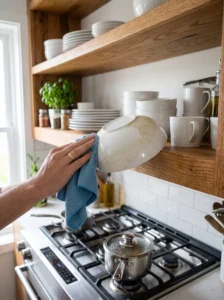
Cooking releases airborne grease particles, especially with stovetop frying, sautéing, or anything done at higher heat. Closed cabinets shield dishes from this entirely. Open shelves don’t.
Over weeks, a thin, almost invisible film builds up on plates, glasses, and mugs sitting in the open — even shelves that aren’t directly above the stove. You won’t notice it glass by glass. You’ll notice it when you go to use a “clean” mug and it feels faintly tacky.
Dust Is Relentless, Even in Closed Rooms
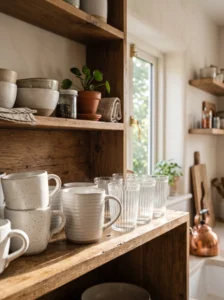
Dust settles on every open surface, kitchens included. A glass sitting untouched on an open shelf for two weeks needs a rinse before use, even if it looks fine to the eye. Multiply that by every dish you own, and dish-washing-before-using becomes a quiet, recurring chore nobody budgeted for.
Practical Fix If You Already Have Open Shelves
- Rinse dishes before first use if they’ve sat for more than a few days
- Wipe shelves weekly with a damp cloth, monthly with a degreasing spray near cooking zones
- Store everyday dishes (used within 48 hours) separately from “display” dishes used rarely
The Hidden Discipline Open Shelving Demands
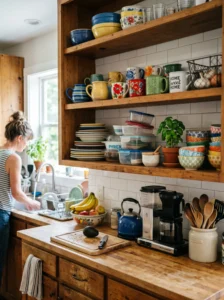
Closed cabinets forgive chaos. Open shelving does not.
Mismatched mugs, half-empty cereal boxes, or that one ugly plastic container you keep for leftovers — all of it is visible, all the time, to you and to guests. This isn’t a design flaw; it’s simply how visibility works.
I’ve watched people buy entirely new dish sets just to make their open shelving “work,” spending hundreds of dollars solving a problem that closed cabinets solve for free.
Who This Discipline Suits
- People who already keep minimal, matching dish sets
- Households without small kids generating constant clutter
- Cooks who naturally put things away immediately after use
Who Struggles With It
- Large families with mismatched, mixed-brand dishware
- Renters or budget-conscious households not ready to buy a new matching set
- Anyone who finds tidying-for-looks stressful rather than satisfying
Where Open Shelving Actually Performs Well
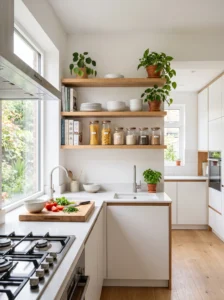
Open shelving isn’t a bad idea — it’s a misapplied one in certain spots. Used correctly, it adds genuine warmth and function to a kitchen.
Strong Locations
- Away from the stove and sink — far less grease, splatter, and steam exposure
- Above counters used for prep, not cooking — lower dust and moisture buildup
- In a butler’s pantry or secondary kitchen zone — display-focused, lower daily traffic
- For items you use almost daily — coffee mugs, everyday glasses, cookbooks — since frequent use naturally limits dust buildup
Weak Locations
- Directly above the stovetop — the worst spot; heaviest grease and heat exposure
- Beside the sink — constant splash and humidity affects wood shelving especially
- In high-humidity kitchens without good ventilation — moisture warps wood and dulls metal over time
The Compromise Nobody Talks About: Mixed Shelving
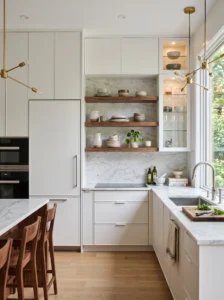
Most professional kitchen designs I’ve seen succeed quietly use a hybrid approach rather than going fully open or fully closed.
A typical mixed layout looks like this:
- Closed cabinets for everyday dish storage, pantry goods, and anything you don’t want grease-exposed
- One or two open shelves in a low-traffic, low-grease zone for display items, cookbooks, or a curated few pieces
- Glass-front cabinets as a middle ground — visual openness without the dust and grease exposure
This hybrid model gets the visual warmth people love about open shelving while keeping the practical, daily-use storage protected. It’s also far easier to resell a home with, since not every buyer wants fully open kitchen storage.
Practical Tips If You Still Want Open Shelves
If you’ve read all this and still want open shelving — and plenty of people genuinely should, because it does look beautiful and feels more spacious — here’s how to do it smartly.
Choose the Right Material
- Wood shelves warm up a kitchen but need sealing to resist moisture and grease absorption
- Metal or glass shelves wipe clean far more easily than raw wood
- Avoid unfinished or porous materials near cooking zones
Get the Depth and Spacing Right
- 10–12 inches of depth suits most plates and bowls without overcrowding
- Leave at least 1.5x the height of your tallest item between shelves for easy reach
- Avoid cramming shelves edge to edge — visual breathing room is what makes open shelving look intentional rather than cluttered
Build a Light Cleaning Routine
- Quick wipe-down weekly
- Deeper degrease monthly, especially shelves within 4–5 feet of the stove
- Rotate rarely-used display items so dust doesn’t settle undisturbed for months
Key Takeaways
- Open shelving looks effortless in photos but requires real, ongoing maintenance in daily life
- Grease film and dust buildup on dishes are the most underestimated downsides
- It demands a tidier, more curated dish collection than closed cabinets do
- Placement matters enormously — avoid the stove and sink zones
- A mixed approach (some open, mostly closed) often gives the best of both worlds
- Material choice and a light weekly cleaning habit make open shelving far more livable
Conclusion
Open shelving isn’t a design mistake, and it isn’t a design miracle either — it’s a trade-off. You’re exchanging some of the forgiving privacy of closed cabinets for visual openness, and that openness comes with real maintenance costs that rarely make it into the photos.
If you go in knowing about the grease, the dust, and the daily tidying it asks for, you can plan around it: smart placement, the right materials, and a realistic cleaning rhythm. Go in blind, and it’s one of the most common kitchen regrets homeowners mention a year after installation.
The honest answer is simple: open shelving works best as part of a kitchen, not the whole strategy for one.
FAQ: Open Shelving in the Kitchen
1. Is open shelving in the kitchen actually a bad idea?
Not inherently. It’s a bad idea for high-grease, high-humidity zones like directly above a stove, and for households that don’t want the upkeep of regular wiping and curated dish storage. It’s a strong idea for low-traffic display zones, secondary kitchen areas, or households with naturally minimal, matching dishware.
2. How often do you need to clean open kitchen shelves?
A quick wipe weekly handles dust, while a more thorough degreasing clean once a month is recommended for shelves within several feet of the stovetop. Shelves farther from cooking heat can often go longer between deep cleans.
3. Does open shelving make a small kitchen look bigger?
Yes, generally. Removing upper cabinet doors creates visual openness and reduces the boxy, enclosed feeling small kitchens often have. The trade-off is that everything on display needs to stay relatively tidy and uniform to keep that spacious feeling intact.
4. What’s the best material for open kitchen shelves?
Sealed wood offers warmth but needs upkeep against moisture and grease. Metal and glass shelving are easier to wipe clean and tend to hold up better in higher-humidity or higher-traffic cooking areas. The right choice depends on how close the shelves are to the stove and sink.
5. Can you mix open shelving with regular cabinets in the same kitchen?
Absolutely, and many designers consider this the most practical approach. A common layout keeps closed cabinets for everyday dishes and pantry items, while reserving one or two open shelves in a lower-traffic spot for display pieces, cookbooks, or frequently used mugs and glasses.