

Kitchen hardware can transform a space for almost nothing — or cost a fortune and barely register. Here’s what actually makes a difference and what you’re just paying extra for.Spend twenty minutes in any kitchen showroom and you’ll encounter at least one set of cabinet pulls that costs more than most people spend on groceries for a week. They look extraordinary on the display board — heavy, perfectly finished, substantial in the hand. The question nobody asks in that moment, but should, is whether they’ll look any better than the forty-dollar version once installed on actual cabinets in an actual kitchen twelve feet away from where you’re standing.
Sometimes they will. Often they won’t. The gap between hardware that genuinely upgrades a space and hardware that merely signals expense is wider than showrooms have any incentive to tell you, and learning to tell the difference changes how you spend on this category permanently.
What Hardware Is Actually Doing in a Kitchen
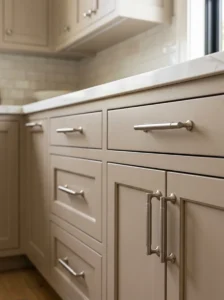
Before evaluating any specific piece, it helps to understand the two jobs hardware is performing simultaneously, because most people focus on only one of them.
The obvious job is tactile and functional — something to grab, to pull, to push. Hardware that’s too small makes cabinets harder to open. Hardware that’s poorly placed strains the wrist over time. Hardware with a finish that deteriorates quickly looks worse with every passing month.
The less obvious job is visual punctuation. Hardware is the repeated detail across every cabinet face — the same element appearing twelve, twenty, thirty times across the most dominant surface in the room. When hardware is right, it reads as a quiet rhythm that gives the cabinets unity and finish. When hardware is wrong — wrong scale, wrong finish, wrong style — it repeats that mistake at every single door and drawer. Nothing in a kitchen is multiplied more times than the hardware choice.
This multiplication is why hardware has outsized visual impact relative to its size, and why a hardware change is one of the most cost-effective upgrades in any kitchen.
Finish: The Decision That Matters Most Long-Term
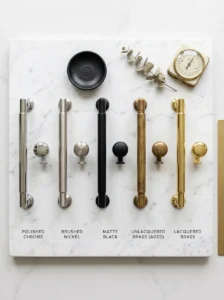
Of everything that goes into a hardware choice, finish has the greatest effect on how the hardware reads in a kitchen and how well it holds up over time. It is also the decision most likely to be made based on what looks good in a store under showroom lighting rather than what performs well in a kitchen under real conditions.
Polished chrome and nickel photograph beautifully and show every fingerprint, water spot, and smudge in daily use. In a household that actually cooks, these finishes require regular wiping to maintain the look that made them appealing in the first place.
Brushed or satin finishes in the same metals — brushed nickel, brushed stainless — hide marks and daily contact considerably better than their polished counterparts. They still look refined but they read as lived-in rather than requiring constant attention.
Matte black has been the dominant hardware trend for several years and remains strong — partly because it reads as bold and current, but more practically because it hides marks extremely well and maintains its look across varied kitchen colors. Its longevity risk is trend-specific: matte black hardware chosen in 2022 may read as “of that era” by 2030 in a way that a brushed brass or brushed nickel wouldn’t.
Unlacquered brass and aged brass age in a way most finishes don’t — they develop a patina over time that becomes richer rather than worse. This is the hardware equivalent of leather aging well. It requires no maintenance and improves with contact. The tradeoff is that it suits specific kitchen aesthetics — warm, layered, somewhat traditional or transitional — and looks out of place in colder, more minimal kitchens.
Lacquered brass achieves the warm gold tone of brass with a protected surface. It looks consistent for longer but eventually chips or wears at the touch points, at which point the exposed underlying material creates a patchwork that’s difficult to repair and looks worse than aged unlacquered brass does at any stage.
The Finish Consistency Rule
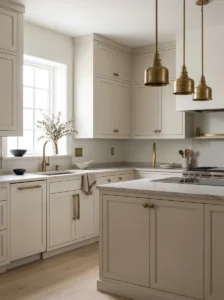
Whatever finish is chosen, it should be consistent across all hardware in the kitchen — and ideally coordinated with the faucet, the sink hardware, and any visible appliance handles. A kitchen with brushed nickel pulls, a matte black faucet, and chrome light fixtures is not an eclectic mix — it’s three things that couldn’t agree on a direction. One metal family throughout the kitchen reads as deliberate. Two is sometimes defensible. Three or more is visual noise.
Scale and Proportion: The Most Underestimated Hardware Variable
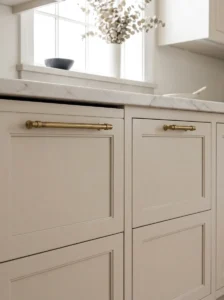
Here is the mistake that shows up most often in otherwise well-designed kitchens: hardware chosen in the wrong scale for the cabinet doors it’s installed on.
A small cup pull on a large 36-inch drawer front disappears. A long bar pull on a small upper cabinet door overwhelms it. Scale isn’t about preference — it’s about proportion, and proportion is either correct or it isn’t in a way the eye registers immediately, even when the viewer can’t name what’s wrong.
A practical guide for sizing:
For drawer fronts, the pull length should be roughly one-third of the drawer’s width. A 15-inch drawer reads best with a 5-inch pull. A 30-inch drawer reads best with a 10-to-12-inch pull. Pulls that are too short look like they were installed by mistake.
For cabinet doors, knobs and small pulls work well on narrower doors and upper cabinets. Bar pulls read better on larger or taller doors. On very tall pantry-style doors, a second pull or a longer bar pull becomes both practical and proportionally correct.
The scale error most people make when upgrading hardware themselves is choosing a size that looks right in their hand at the store, not one that looks right on the specific door it’s going onto. Measure first. Consider the door size. Then choose.
Bar Pulls vs Knobs: A Practical Answer
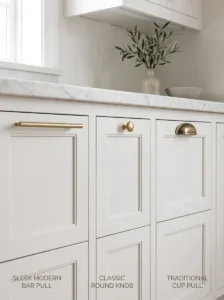
This question gets treated as purely stylistic when it’s actually partly functional.
Knobs are sufficient for doors where a single-point pull is all that’s needed — upper cabinet doors, narrower drawer fronts. They read as slightly more traditional or transitional in style. They’re also the more economical choice since one knob per door is the standard versus one or two pulls.
Bar pulls are better for wider drawers and lower cabinet doors where a two-point grip is more comfortable and natural. They also read as more contemporary. The practical advantage is meaningful: a bar pull on a deep lower drawer allows a more comfortable and controlled pull than a single knob does.
Cup pulls occupy a middle ground — traditional in profile, used primarily on drawers. They’re making a notable return alongside inset cabinetry and more Shaker-influenced kitchens. Functionally similar to bar pulls for drawers, slightly warmer in visual character.
The cleanest approach for most kitchens: bar pulls on drawers throughout, matching style knobs or pulls on cabinet doors, consistent finish across both.
What “Expensive-Looking” Hardware Actually Signals
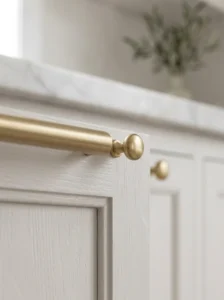
There are a few specific qualities that read as expensive in kitchen hardware regardless of actual price, and understanding them explains why some budget hardware looks premium and some premium hardware looks like budget hardware at twice the cost.
Weight and solidity: Hardware that feels substantial in the hand and doesn’t rattle when installed reads as quality. This is a function of material and construction, not price category. Solid brass hardware, even at a moderate price, reads as expensive because it has genuine weight. Hollow or thin-walled hardware at a premium price reads as cheaper than it costs.
Clean finish at the edges: The detail that most clearly distinguishes quality hardware from inexpensive hardware at visual distance is the crispness of the finish at the edges and ends. Blurry or uneven finishing at the terminal points of a pull or the edge of a knob reads as manufacturing imprecision regardless of the finish color.
Mounting hardware that disappears: Visible screw faces, misaligned mounts, or hardware that sits slightly off the cabinet surface all undermine the visual effect of good hardware. Quality hardware is designed so the mounting disappears. When the installation is clean, the hardware reads as part of the cabinet rather than attached to it.
The Hardware Mistakes That Date a Kitchen Fastest
A few specific choices reliably signal a specific era of renovation and little else:
Oversized ornate pulls in a transitional kitchen: The large, sweeping decorative pulls that were popular in mid-2000s renovations look immediately dated in a way simpler hardware doesn’t. Ornate hardware from any specific trend era dates a kitchen to that era.
Matching everything too precisely: Hardware that matches the faucet, the light fixtures, the appliance handles, and every other metal element in a kitchen in the exact same finish can read as an interior decorator’s package deal rather than a considered personal selection. Small variations — same metal family, slightly different finish — look more natural and less of-an-era.
Trendy shapes from a specific moment: Geometric pulls with very specific shapes — the particular curve or angle that defines a trend rather than a classic — age faster than simpler forms. Cylindrical, bar, and simple rounded forms have proven longevity. Highly specific trend shapes don’t.
Where to Spend and Where to Save
Not all hardware is worth the same investment, and being deliberate about where to allocate budget produces better results than spending uniformly.
Spend on: The faucet. This is the piece of hardware touched most frequently, most visibly positioned, and most likely to read as either quality or compromise. A quality faucet with a durable finish justifies a higher spend more than almost any other hardware item in a kitchen.
Spend on: Cabinet pulls for the lower zone — the drawers and doors you touch most, where weight and finish durability matter most under daily contact.
Save on: Upper cabinet knobs and pulls, which are touched less frequently, seen from greater distance, and replaced more easily if preferences change.
Save on: Interior cabinet hardware — hinges, drawer slides — unless your cabinet doors and drawers are operating noticeably poorly, in which case soft-close hinges and undermount drawer slides are worth every dollar for the daily experience they produce.
Key Takeaways
- Hardware performs two jobs — functional grip and visual rhythm — and failing at either multiplies across every cabinet in the kitchen
- Finish affects daily maintenance more than any other hardware variable; brushed and matte finishes outperform polished ones in working kitchens
- Scale relative to the cabinet door or drawer matters as much as style — measure first, choose second
- Weight, edge finish crispness, and clean mounting are the signals the eye reads as expensive, regardless of actual price
- Consistency across all metal elements in the kitchen reads as deliberate; mixing multiple finishes reads as indecision
- Budget highest on the faucet; save on upper cabinet hardware touched least frequently
- Trend-specific shapes date a kitchen; simple, classic forms have proven staying power
Frequently Asked Questions
Can changing only the hardware meaningfully upgrade old or builder-grade cabinets? Yes, often dramatically so. Builder-grade cabinets with poor original hardware can read several quality levels higher with a well-chosen, well-scaled replacement. The cabinet boxes and doors themselves don’t change, but the detail that’s touched and seen at close range every day does. It’s one of the most return-efficient kitchen upgrades available without touching the cabinets themselves.
How many different hardware styles can you mix in one kitchen? One style consistently applied across the entire kitchen is almost always cleaner than mixing. Two styles with a clear logic — cup pulls on drawers, knobs on doors — can work if the finish is unified. Three or more styles introduces visual inconsistency that almost always reads as unresolved rather than eclectic.
Is unlacquered brass really low-maintenance, or does the patina development require management? Genuinely low-maintenance, assuming you’re happy with the direction the aging takes. Unlacquered brass develops a patina from oils in your hands and exposure to air, darkening slightly and unevenly over time. Some people love this effect. Others find it unpredictable. If you want the brass to stay bright and consistent, lacquered brass is the right choice — with the understanding that the lacquer will eventually wear at contact points and require either acceptance or replacement.
Should the faucet and hardware always match exactly? Not exactly, but they should be in the same metal family. Exact matching can look slightly rigid — like everything was ordered from the same catalog page. The same metal in slightly different expressions (brushed versus matte, for instance) looks more naturally considered. Where a contrast is introduced deliberately — a matte black faucet in a mostly brass kitchen, for example — it works when it looks like a choice rather than an oversight.
What’s the fastest hardware upgrade for a renter who can’t make permanent changes? Many landlords allow hardware swaps if the original hardware is kept and restored upon move-out. Store the original hardware carefully, swap to your preferred choice, and reverse when leaving. This costs nothing beyond the hardware itself and is reversible. Always check with the landlord first, but it’s a commonly permitted change that significantly affects how a rented kitchen feels day to day.