


Kitchen cabinet organization that actually lasts isn’t about buying more bins — it’s about a system built around how you really cook. Here’s what that looks like in practice.
The can of chickpeas fell out first. Then a bag of rice slid off the shelf and hit the counter. Somewhere in the back, something rolled — probably the can of coconut milk that had been missing for three weeks. The cabinet was organized four months ago. Somehow it looked worse than before any of that happened.
If this sounds familiar, you’re not disorganized. You’re using a system that was never built for how you actually cook.
Most kitchen cabinet organization advice focuses on containers, labels, and categories — baking here, canned goods there, spices alphabetized — and then acts surprised when the whole thing collapses within a season. The problem isn’t the containers. The problem is that the logic behind the system ignored the one thing that matters most: how a real person moves through a kitchen on an ordinary Tuesday.
Why Most Organization Systems Fail Within Months
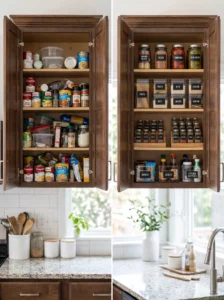
Here’s what usually happens. Someone reorganizes their cabinets carefully, puts everything in matching bins, labels everything clearly, and feels good about it for a few weeks. Then life resumes — groceries get unloaded quickly, dishes get put away at the end of a long evening — and items gradually drift back to wherever they get put down first rather than where the system says they should go.
This isn’t a willpower problem. It’s a friction problem.
When a system requires more effort to maintain than the alternative of just putting things down wherever, the system loses. Every time. The cabinets that stay organized long-term aren’t the most elaborate ones — they’re the ones built so that the organized position and the easiest position are the same thing.
That’s the actual goal: make it easier to put things back correctly than to put them anywhere else.
Start With the Audit Nobody Wants to Do
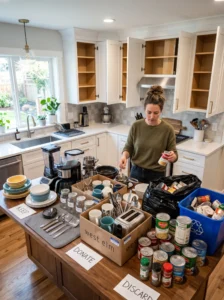
Before a single bin gets purchased or a single shelf gets cleared, pull everything out. Every cabinet, every shelf, every forgotten corner. All of it, on the counter or the table at once.
This step feels tedious and it is the most important one. You cannot build a system around what you think is in your cabinets. You need to see what’s actually there — including the expired cans from two years ago, the duplicate vegetable peelers, the gadget bought for one recipe and never touched since.
While everything is out, make three piles: keep, donate, throw away. Be honest about the donate pile in particular. A cabinet system built around things you don’t actually use is just organized clutter.
When you put things back, you’re only putting back the keep pile. This alone — without any new bins or systems — usually solves a third of the cabinet-space problem immediately.
The Zone System: Organize by Activity, Not by Category
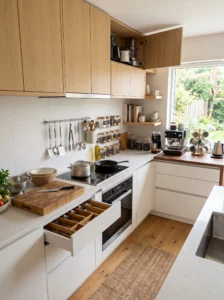
This is the organizing principle that separates functional kitchen cabinets from ones that just look nice on a YouTube video.
Most people organize by category — all baking supplies together, all canned goods together, all spices together. This makes sense intellectually. It makes less sense when you’re mid-recipe with oily hands, standing at the stove, needing the cumin that’s stored on the opposite side of the kitchen because it lives with the “spices” rather than near the stove where you actually use it.
The zone system organizes by where things get used instead:
Cooking zone — the area around the stove and oven. This is where oils, frequently used spices, cooking wines, and the pans you reach for weekly should live. Not across the kitchen. Right here.
Prep zone — the main counter where food gets cut and assembled. Cutting boards, mixing bowls, measuring cups, and tools like peelers and graters belong in a cabinet at or adjacent to this spot.
Coffee and breakfast zone — wherever the kettle or coffee maker lives. Mugs, filters, coffee, tea, breakfast cereals — all of this organized together and close to where it’s used means one morning trip to one cabinet instead of three.
Storage zone — deeper, higher, or harder-to-reach cabinets for the things used occasionally: the slow cooker, the stand mixer, the roasting pan that comes out at holidays. These don’t need to be convenient. They just need to exist somewhere that doesn’t block daily access.
Reorganizing by activity rather than by category usually means moving things to positions that feel slightly wrong at first — the olive oil near the stove instead of with the “oils and vinegars” section — and feeling immediately right within a week of actual cooking.
The Frequency Rule: Front, Middle, Back
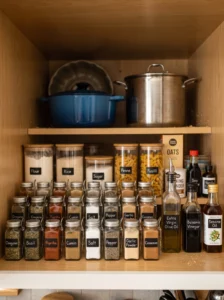
Within each zone, one rule governs placement more than any other: how often you reach for something determines where it lives on the shelf.
Daily use items — front of the shelf, at eye or hand height, no reaching required. These are the things you touch every single cooking session. They should be impossible to miss and require zero effort to grab.
Weekly use items — middle of the shelf, perhaps one small reach back or a half-step. Used regularly but not every time.
Monthly or occasional items — back of the shelf, high up, or in a less accessible cabinet. Accessed intentionally when needed, not stumbled over constantly.
The most common cabinet organization mistake I see is the reverse of this — everyday items buried behind occasional ones, or tucked into high, hard-to-reach spots because they’re small and look tidy there. Tidiness that fights your daily routine always loses to the routine.
What to Actually Do With Deep Cabinets
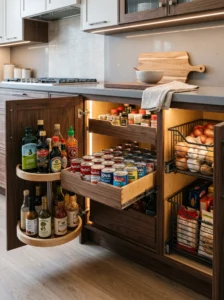
Deep cabinets are where organization systems go to die. Things get pushed to the back, then forgotten, then rediscovered expired. The problem isn’t depth — it’s invisibility. Anything you can’t see, you won’t use.
A few approaches that work better than standard shelf placement:
Turntables (lazy Susans) for corner and deep cabinets — spin to access what’s in the back without emptying the front. Works especially well for oils, vinegars, sauces, and canned goods.
Pull-out bins or drawers installed inside deep lower cabinets — transform a cave into something you can actually access without getting on your knees. These are the highest-return cabinet organizer purchase available.
“First in, first out” stacking for canned goods — new cans go behind older ones so you naturally use the oldest items first. A small thing that prevents the chronic problem of identical cans with wildly different expiration dates.
Shallow bins at the front of deep shelves as a visual boundary — anything behind the bin is “back stock,” anything in front is current, accessible, and in rotation.
The Vertical Space Nobody Uses
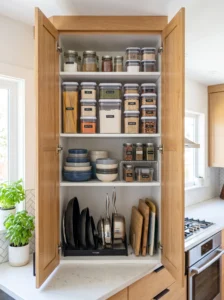
Look at the gap between the top of a soup can and the shelf above it. In most kitchen cabinets, this gap — multiplied across every shelf — represents significant unused space that could either hold more items or be eliminated by adjusting shelf height.
Shelf risers double the usable space on a single shelf by creating a raised second tier behind and below the front row. Particularly useful for spices, canned goods, and small jars where items at the back would otherwise disappear.
Adjustable shelves — if your cabinets have them, actually adjust them. A shelf set for the height of a blender doesn’t need to be that high for canned goods. Resetting shelf height to match what actually lives there removes the wasted vertical space that most factory-set shelf positions create.
Stacking where it makes sense — bowls, Tupperware lids, sheet pans, and cutting boards can all stack or stand vertically on a wire rack, turning a pile of flat items into an organized vertical row you can pull from individually without lifting everything above it.
The Specific Cabinet Problems Worth Solving Separately
The Corner Cabinet
Almost every kitchen has one. Almost none of them work well. A standard blind corner cabinet — the one with the small door and the vast invisible cave behind it — is one of the most reliably dysfunctional storage spaces in any kitchen.
If a renovation is possible, a pull-out corner drawer system or a magic corner unit transforms the space entirely. Short of that, use the visible accessible portion for items you actually need and accept that the deep back corner is better left empty or used only for large, rarely-used items you can retrieve deliberately.
The Spice Cabinet
Alphabetical order sounds logical. It’s the wrong system. Organize spices by cooking style instead — baking spices together, warm savory spices together, dried herbs together, heat and chili family together. This matches how you actually reach for them while cooking, which is usually “I need something in the cinnamon-cardamom family” rather than “I need the specific spice that starts with C.”
Pull-out tiered spice racks or a small turntable inside the cabinet also prevent the endlessly frustrating problem of every spice having to be moved to find the one at the back.
The Tupperware Cabinet
This is usually the worst cabinet in the kitchen. Lids and bases separated, nothing stackable, nothing findable. The fix is either nesting all containers with their lids stored separately in one dedicated spot, or switching primarily to one brand and size that actually stacks with itself. A matching set of one stackable container type takes up less space and loses fewer lids than five mismatched brands sharing a shelf.
Keeping It Organized After Day One
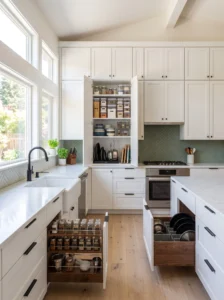
The audit and the reorganization are a single afternoon of work. The system staying organized is a daily habit, and that habit needs to require almost no effort or it won’t stick.
Three things that reliably help:
Put groceries away into the system, not onto the counter. When new items come in, they go directly to their zone position rather than sitting on the counter until “later.” This five-minute habit prevents the gradual drift that undoes most organization projects.
Do a quick quarterly audit. Not a full reorganization — just fifteen minutes of pulling things out to check expiry dates, returning strays to their home positions, and making one or two small adjustments as cooking habits shift.
Don’t buy more organizing products to solve a storage problem. When cabinets feel full again, the first response should be another edit — removing what’s not being used — not another bin purchase. More containers in the same space just moves the clutter into labeled boxes.
Key Takeaways
- Organization fails when the system requires more effort to maintain than ignoring it — reduce friction first
- Pull everything out before building any system; editing what you own solves more than any organizer can
- Zone by activity, not by category — items live where they get used, not where they “belong” logically
- Frequency determines placement: daily items front and accessible, occasional items back and high
- Deep cabinets need turntables or pull-outs to stay functional; shelving alone creates invisible dead zones
- Adjust shelf heights to match what actually lives there; factory settings rarely fit real kitchens
- A fifteen-minute quarterly edit keeps systems from gradually reverting to chaos
Frequently Asked Questions
How long does it actually take to properly organize kitchen cabinets? The full audit and reorganization — pulling everything out, editing, and putting back into a new system — usually takes between three and five hours for a standard kitchen. Rushing it produces a half-system that collapses quickly. The time spent upfront is repaid daily in the small friction removed from every cooking session afterward.
Is it worth buying matching containers and bins before reorganizing? Almost always no, at least not before the audit. Buying organizing products before knowing what you’re keeping and where things will live leads to buying the wrong sizes, wrong quantities, and solutions for problems that editing might eliminate entirely. Audit first, then buy only what the specific gaps actually require.
Should spices be stored in the cabinet, in a drawer, or on the counter? It depends entirely on your cooking frequency and counter space situation. Frequent cooks with adequate drawer space often find a flat drawer with spices lying label-up to be the most functional option — every label visible at once, no reaching. Less frequent cooks or those with limited drawer space do well with a tiered cabinet shelf or a turntable. Counter placement near the stove is convenient but exposes spices to heat and light that shortens their shelf life faster than either drawer or cabinet storage.
What’s the best way to handle a small kitchen with genuinely not enough cabinet space? Edit more aggressively than feels comfortable. Most kitchen cabinet space problems are partly a storage problem and partly an “owning too much kitchen stuff” problem. After the most aggressive edit possible, focus on vertical space inside the cabinets and consider whether any items currently in cabinets could live elsewhere — a pantry closet, a rolling cart, or a small shelf in an adjacent room.
How do you stop family members from disrupting the cabinet system? Make the correct position easier than any alternative. If the logical home for something is obvious and requires the least effort to reach, most people default to it naturally. Where a system requires extra thought or effort — opening a specific bin, finding the label, reaching past other things — it will get bypassed. Design the system for the least attentive person in the household, not the most organized one, and it will hold up considerably better.